

Tips for Protecting Yourself from Scams
Clients often call us after they have been a victim of a scam, but unfortunately there is often nothing we can do through the court system to recover funds once they are gone. The growth of A.I. and the internet in general has only intensified this problem. Therefore, the best way to protect your assets is to be proactive and vigilant.
Types of Scams
Scams come in many different forms and are sometimes so believable that it can be difficult for even the most careful people to protect themselves. To better understand this problem, here is a list of a few common types of scams and examples:
· “Phishing/Spoofing”Scam: This is themost common form of scams. A scammer sends an unsolicited message through anemail, text or phone call acting like they are a legitimate company ororganization asking for your personal or financial information.
“Phishing” Scam Example: You receive a text message from your law firm, they have never texted you before, but at first glance it seems legitimate. The phone number is from the right area code, and the contact ID may even match your law firm’s name. In the text, your supposed law firm says you have just been sued and for you to be represented by your law firm, you need to click on the link in the text. This is a scam. You should never click on links from unexpected and/or unknown sources of communication without further verification.
· “Tech/Customer Support” Scam: A scammer will pose as either a technical or customer support representative saying that they need to fix or change something. They may say they need remote access to your devices or that they need your personal information.
“Tech Support” Scam Example: You receive a phone call from a person who says they are from “Google” and that your data has been hacked and found on the “dark web”. They may already know your name, address, email, and some other information. They say to fix your hacked data you must go to your computer and enter a command code which gives them control of your computer. This is a scam. Google, and most other organizations, will rarely call you unexpectedly and will never ask for control of your computer.
“Phishing/Customer Support” Scam Example: A “bank” contacts you, they say your account has been compromised. They send you an unfamiliar link to a website to “secure your account”. They ask you to enter your personal account information in that website. This is a scam. Scammers can figure out which bank you use and pose as customer support to act like they are real representatives. If a bank contacts you unexpectedly, verify they are using the same source of communication they have used before with you. In instances of new websites, verify the unfamiliar website’s URL.
· “IRS” Scam: This scam involves someone posing as an IRS agent where they may either say that you have a huge tax refund waiting or that you have taxes overdue. Usually, they will either ask for personal information or demand payments, otherwise they claim you will be sent to jail or have fines imposed on you.
“IRS” Scam Example: You receive an email from an organization called “IRS Tax Collection Agency”. They claim in the email that you paid far less in taxes than you should have. They say that if you don't pay within three days of receiving the email they will have law enforcement arrest you. This is a scam. The real IRS will never initiate contact for the first time with you online unexpectedly, instead they will almost always send you a physical letter in the mail. The real IRS will also never use such overt threats nor impose such a short time frame.
· “Grandparent” Scam: A scammer will contact you posing as a grandchild or other relative. They ask you to help them out financially by saying they have an emergency. They may even use A.I. to change their voice to sound more like your relative.
“Grandparent” Scam Example: You receive a phone call from an unknown number. When you answer it sounds like it could be your grandson. Your grandson says he is lost in another state or country and he desperately needs money. He asks you not to tell anyone else since it is embarrassing. This is almost always a scam. Call the relative through a trusted phone number you have used before. If they don’t respond, ask other family members to verify the story. Don't implicitly trust the voice on the other side of the phone as A.I can fake it.
· “Prize” or “Package” Scam: This scam involves a person or organization communicating that you have won a prize or contest in which you will receive some type of gift. They may ask you to send “fees” in order to collect this gift, or they may ask you to scan a QR code to redeem it.
Prize/Package Scam Example: You receive a text saying that you have won $5000 dollars from entering a contest. You have no recollection of entering this contest and the text states that you must pay a “processing” fee of $200 to collect this prize. If you have no recollection of entering a contest and/or they ask you to pay some type of feeto collect- it is a scam.
Tips on how to protect yourself
To better protect yourself and improve your security here are a few tips in dealing with scammers:
· Never click on links from unknown sources. In cases of emails or texts that seem to be from people or organizations you know, ask them from a trusted communication if they really did send that link. For emails, look at the sender’s actual email address, not just the name of the emailer.
· Be wary of answering unknown phone numbers that call you. Either let the call go to voicemail or be vigilant that this can be a scam. Scammers can even fake a caller ID- making it appear more trustworthy.
· Don’t fall for urgency. Scammers will usually say you have to give your information now or pay a fee immediately otherwise something bad will happen.
· Use caution when talking to friends or family through an unknown number. Verify they are indeed your friends or family by calling them back through the number you have used before with them.
· Verify companies or organizations that contact you. They should only contact you through trusted emails and phone numbers, or through sending letters by mail. Authenticate from a trusted source that communication is legitimate.
· Don’t always believe a picture, video, or the sound of someone’s voice. Scammers can use A.I. to fake this information. Even in video calls such as facetime or zoom, scammers can change their appearance and voice through using A.I.
· Look for bad grammar in unsolicited texts or emails. A scammer may use bad grammar to get past filter systems or to make the communication seem more “authentic”.
· Ask verifying questions.If something just feels “off”, ask the organization or person aboutinformation only they would know and which is not available online.
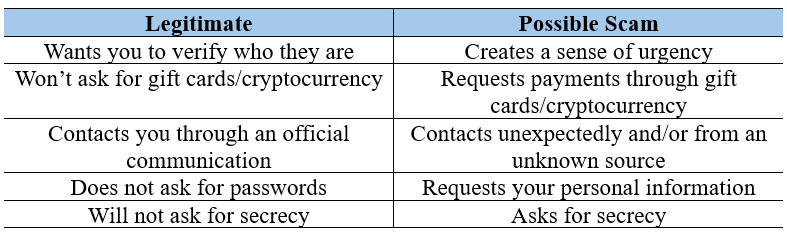
Here are a few red flags to watch for when dealing with potential scams:
What to do if you are a victim of a scam
If you suspect someone has stolen your personal information, you should contact your bank and explain the situation to them. This will allow them to limit transactions and place more scrutiny on your accounts. They may give you some further instructions on how to fix this issue.
Additionally, you should contact law enforcement. Let them know what you suspect has happened so that they can investigate it. Keep in mind however, that if you sent money to a potential scammer or gave them login credentials, it is highly unlikely you will recover your lost funds.
Finally, you should freeze your credit report. This is done through a “security freeze”, which means that all creditors cannot access your credit report. This will keep creditors from approving any new credit account for you whether it is fraudulent or legitimate. This can be done by contacting each of the three major credit reporting agencies. One way to contact them is by calling each of these phone numbers:
Equifax: 888-29-0045
Experian: 888-397-3742
Transunion: 800-916-8800.
Final Thoughts
Scams can be devastating to your personal wealth as well as your entire family’s finances. In some cases, victims of scams lose their entire life savings. In this growing online world, it is now more important than ever that you protect your savings from those who would want to take it. Through being prudent and taking your time- you can protect your wealth and improve your financial security.
If you need assistance with your estate planning in Washington County, Ozaukee County, Dodge County, Fond du Lac County, or one of the local communities such as West Bend, Jackson, Hartford, or Germantown, the experienced Wisconsin estate planning attorneys at Schloemer Law Firm, S.C. can guide you through every step of the process.
If youhave questions about this article or need assistance, please contact one of theWisconsin Estate Planning Attorneys at Schloemer Law Firm, S.C or thisarticle’s author Attorney Amanda N. Sacks at 262-334-3471 or info@schloemerlaw.com.
Originally published: July 30, 2026
More Important Reading
- Giving the Gift of an Education
- Estate Tax Cliff
- Estate Planning for Mixed Families and Second Marriages
Disclaimer: The information contained in this post is for general informational purposes only and is not legal advice. -Due to the rapidly changing nature of law, Schloemer Law Firm makes no warranty or guarantee concerning the accuracy or completeness of this content. You should consult with an attorney to review the current status of the law and how it applies to your unique circumstances before deciding to take—or refrain from taking—any action. If you need legal guidance, please contact us at 262-334-3471 or info@schloemerlaw.com.